

Most companies pick a software localization vendor the same way they pick any B2B service. Compare feature lists. Get a few quotes. Check references. Sign. Then six months in, something feels off and switching means migrating assets, retraining people, and losing months.
I run a localization company, so I’m not an outside observer. But as a boutique operation competing against companies fifty times our size, I have less reason to sugarcoat how the localization services industry actually works behind the scenes.
None of what follows is because vendors are dishonest. The incentives in this industry make certain truths inconvenient. Response times get longer. The same mistakes keep showing up. The project manager who knew your product gets replaced by someone starting from scratch. Nothing breaks overnight. But the gap between what you expected and what you got keeps growing.
- The People on the Sales Call Aren't the People Doing the Work
- Hidden Costs Your Software Localization Vendor Won't Mention Upfront
- "We Integrate with Everything" Usually Means They Have an API
- What Every Software Localization Vendor Gets Wrong About Quality
- Where Your Software Localization Vendor Sends Your Budget
- What to Ask a Software Localization Vendor Before You Sign
The People on the Sales Call Aren’t the People Doing the Work
Large software localization vendors run polished sales processes. Senior account executives, tailored presentations, deep discovery calls. The experience feels personal.
Then you sign. And you get handed to a project manager who handles 30 or 40 other accounts. They’re measured on monthly throughput, not on how well they know your product. Your questions get answered, but not always fast. Your preferences get noted, but not always followed.
This is a structural reality. When a software localization company scales to hundreds of clients, specialization happens. Sales teams sell. Delivery teams deliver. Different people, different priorities. That’s how large organizations work.
The problem shows up when something goes wrong. Your PM doesn’t have the context to escalate properly. They don’t have the authority to make decisions quickly. And from what we’ve seen with clients who’ve switched to us, problems really only get addressed once you signal you’re about to leave. Harvard Business Review covered this pattern directly, noting that B2B acquisition costs often exceed first-year revenue, while customers with low switching barriers can walk away the moment delivery doesn’t match the sales experience.
At a smaller operation, the people are closer to the work. Decisions happen faster because there aren’t three layers of approval between a problem and a fix. At Native, you’ll talk to me first, and your dedicated project manager joins the conversation early. The chain stays short throughout the relationship.
That doesn’t mean boutique is always better. But you should know who you’re actually working with before you commit.
Hidden Costs Your Software Localization Vendor Won’t Mention Upfront
Per-word rates look straightforward. They’re not.
Many software localization vendors add charges that don’t show up on the first quote. Project management fees at 15-20% of the translation cost. Minimum order surcharges for small batches. Revision fees after the first round. Rush premiums on timelines that most teams would consider normal.
None of these are unreasonable on their own. Running localization projects costs money. But these costs should be visible upfront, not discovered three invoices in.
We don’t charge project management fees. If we get something wrong on the first pass, fixing it is free. We think that should be standard, not a selling point. But in this industry, it’s still uncommon enough to mention.
The better question to ask any software localization vendor: what’s the fully loaded cost for a typical month? Not the per-word rate. The total. Including every fee, every surcharge, every add-on. Compare that number across vendors and the picture changes.
For a detailed breakdown of what drives the price, we covered that in how software localization pricing works.
“We Integrate with Everything” Usually Means They Have an API
Every software localization vendor claims seamless integration. Most SaaS companies coming to a localization partner for the first time have none of the infrastructure that “seamless” assumes.
No translation memory. No established content pipeline. Files in formats that don’t plug neatly into any system. No language asset management. Every time they translate, they start from scratch.
The real conversation should be about building a workflow, not plugging into one. What does your tech stack look like? What’s your release cadence? Do you even need a TMS right now, or would a structured manual process work better for your volume? We wrote about how we approach localization planning at different stages if you want the full picture.
We don’t develop or own any software. We’re not selling a platform. So the first thing we do is figure out what a client is already using and build around that. Sometimes that means connecting to a TMS through a localization API. Sometimes it means working with shared folders and a spreadsheet. Whatever fits.
If your software localization vendor leads the technical conversation with their own platform, ask yourself whether the recommendation serves your workflow or their license revenue.
Why Software Localization Vendor Quality Drifts Over Time
Large vendors don’t ignore quality. They have rigid procedures, certifications, and documented workflows. There’s a reason they’re large. They’ve built systems that work.
The systems work. The execution under pressure, across dozens of accounts, with overloaded PMs, often doesn’t keep up.
The most common complaint from clients who come to us from larger software localization vendors is inconsistency. The same terminology error showing up across multiple deliveries. The same feedback being given, acknowledged, and then appearing again two months later. The same correction requested in January still not applied in March.
This points to a project management gap, not a translation quality problem. When a PM handles 40 accounts, tracking every correction for every client across every language pair takes time that doesn’t exist in their calendar.
Now scale that up. One unresolved terminology inconsistency in one language is a minor annoyance. That same issue replicated across 20 languages is 20 corrections. Twenty review cycles. Twenty emails to twenty different translators or teams. For one mistake that should have been caught after the first flag.
That’s where real frustration builds. Not from a single bad delivery, but from the feeling that corrections disappear into a system that doesn’t retain them. And yet most teams stay, because switching means rebuilding the institutional memory your vendor built about how your product sounds in other languages. That rebuild takes months, and quality usually gets worse before it gets better.
ISO 17100 and ISO 9001 require documented processes for tracking and resolving exactly these issues. Many large LSPs hold these certifications. But a certification is an audit that happened at a point in time. Your project happens every week. The gap between the system on paper and the execution in practice is where quality drifts.
Ask your software localization vendor how they track corrections. Not their quality policy. The actual mechanism. How does feedback from delivery number one make it into the briefing for delivery number two? If the answer is vague, the mechanism likely doesn’t exist in practice.
We covered what localization QA looks like in practice in a separate post, including how correction tracking works when someone actually does it.
Where Your Software Localization Vendor Sends Your Budget
A large LSP might quote €0.40 per word for Scandinavian languages. A boutique might quote €0.18 for the same pair. Most people assume the gap reflects quality. It reflects supply chain layers.
Here’s how €0.40 typically moves through a large software localization vendor’s operation. The LSP keeps roughly half for overhead, sales, offices, and margin. They subcontract the work to a mid-size regional agency. That agency takes their cut and passes the rest to a single-language vendor. The vendor takes a margin and pays the translator.
By the time your €0.40 reaches the person actually translating your product, they might see €0.08 per word. Multiple layers, each one justified, each one adding cost without adding translation quality. The Slator 2025 Language Service Provider Index tracked nearly 300 companies and found that organic growth across the industry was flat. Most reported growth came from mergers and acquisitions, not from winning new clients on quality. Boutique LSPs saw a 3.7% revenue decline while larger providers grew through consolidation.
At a boutique with one layer between you and the translator, €0.18 goes further. A larger share reaches the person doing the work. And that share matters.

A translator working at €0.08 and one working at €0.12 bring very different things to your project. The lower rate gets you someone who handles the language competently. The higher rate gets you domain expertise. Someone who knows your vertical, understands the product context, and catches problems the other wouldn’t recognize.
The math works out: you pay a premium rate at the large LSP, and after the supply chain takes its share, you end up with a less specialized translator than a boutique charging you less. The premium covers operational layers, not deeper expertise.
The trickle-down goes beyond money. Deadlines compress at every layer too. The large LSP promises the client a five-day turnaround. The regional agency gets four days. The single-language vendor gets three. The translator at the bottom gets two days, at the lowest rate, with the least context. That pressure pushes experienced professionals to look for better terms elsewhere. I wrote about the emotional toll this creates on people in the localization workflow for Multilingual Magazine. The talent pool at the end of the chain gets thinner year after year.
What to Ask a Software Localization Vendor Before You Sign
If you’re evaluating software localization vendors right now, here are six questions worth bringing to the conversation. Not because the answers disqualify anyone automatically, but because the way a vendor responds tells you a lot about how the relationship will work.
“Who will manage my account day to day, and can I meet them before we sign?”
This reveals whether you get a dedicated PM who knows your product or a rotation of people working from a brief. If they can’t arrange a call with your future PM, the PM probably hasn’t been assigned yet.
“What’s included in your per-word rate, and what gets charged separately?”
This surfaces hidden costs. Project management fees, revision charges, minimum orders, rush premiums. Get the fully loaded monthly estimate, not the headline rate.
“How do you track corrections between deliveries?”
This reveals whether quality feedback actually loops back into the process. A good answer includes a specific mechanism. A vague answer means the mechanism doesn’t exist.
“Are you building translation memory from day one, and who owns it?”
This tells you whether your language assets are being captured for reuse and whether you can take them if you leave. If the vendor owns the TM, switching later gets expensive.
“What does your translator selection process look like for my project?”
This tells you whether you’re getting vetted specialists or whoever accepted the job at the lowest rate from a marketplace. A good answer describes specific vetting steps and how translators are matched to subject matter.
“Can you show me a working connection with our stack?”
Not a demo environment. Your actual tools. This separates the “we integrate with everything” pitch from reality.
None of these are trick questions. A good vendor will welcome them. If any of them make a vendor uncomfortable, that’s useful information too.

Let’s Have That Honest Conversation
Native is a boutique software localization partner with over 1,200 vetted translators across 120+ languages. We work with SaaS teams, fintechs, and product companies who need localization that keeps pace with their release cycle.
You’ll talk to me first. Your dedicated project manager joins early. No layers between you and the people doing the work. If you’re evaluating software localization vendors and want a straight conversation about what your project actually needs, let’s talk.
Related Content

The full process from internationalization to launch, including how translation fits into your development workflow.
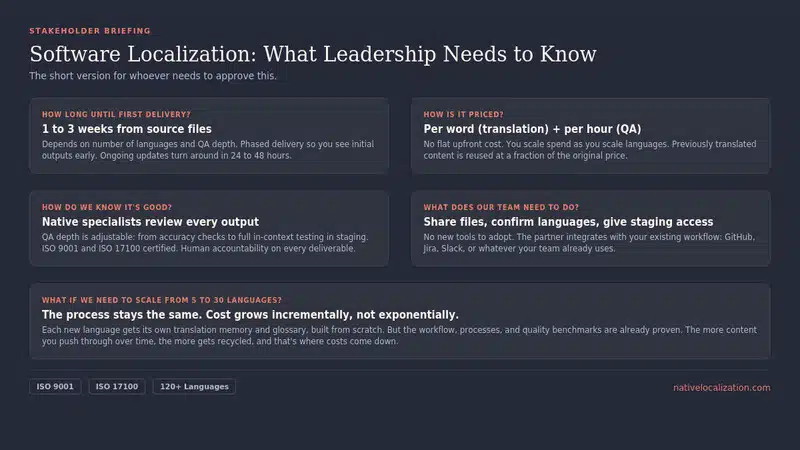
A breakdown of what drives the price, from per-word rates to engineering hours and ongoing maintenance.

What localization QA covers, how much it costs, and what to ask your partner before testing starts.
FAQ
Ask who will manage your account day to day, what’s included in pricing beyond the per-word rate, how they track corrections between deliveries, and whether translation memory is built from day one. Request a meeting with your actual project manager before signing.
Inconsistency across deliveries is the most common complaint. It usually stems from rotating translators and poor feedback tracking rather than translation quality itself. Hidden charges for project management, revision fees, and minimum orders are also frequent issues that only surface after the first few invoices.
Boutique LSPs typically have shorter communication chains, dedicated project managers who know your product, and lower pricing due to less overhead. Large LSPs offer broader infrastructure but often rely on subcontracting chains that increase cost without increasing translation quality. Both can deliver good work. The difference is in how close you are to the people doing it.
Ask about their vetting process and how translators are matched to your subject matter. Some vendors pull translators from open marketplaces where price is the only selection criteria. Others maintain curated networks of tested professionals with domain expertise. Ask whether you can communicate with the person working on your project.
Per-word rates vary by language pair, content type, and level of human involvement. The headline rate is only part of the cost. Many vendors add project management fees (15-20%), revision charges, and minimum order surcharges. Ask for a fully loaded monthly estimate to compare total cost rather than line items.
Translation memory stores every approved translation for reuse in future projects. It works like version control for code. Repeated or similar sentences cost a fraction of the original rate or nothing at all. If your vendor doesn’t set up translation memory from day one and confirm that you own the asset, you’re paying full price for work you’ve already paid for.
One e-mail a week. Smarter localization.
Real localization advice from a team that does it daily. One email a week, worth your time.
You're in.
We'll send you our best stuff. No filler.