

You hired a copywriter. Argued over button labels. Rewrote the onboarding flow three times until it felt natural. The product has a voice. Customers notice it.
Then you expand to new markets. The product gets translated. And everything you built into that English experience just vanishes. The words are all correct. The grammar checks out. But nobody would ever talk that way. Your product went from having a personality to sounding like every other SaaS tool on the market.
That’s a software localization quality problem. And it’s more common than most teams realize.
Where Software Localization Quality Gets Lost
Here’s what makes this frustrating. The companies that struggle most with localized quality are the ones that invested the most in their English copy. They know what good writing sounds like. They fought for it internally. Then they watched it get flattened the moment it crossed a language boundary.
It happens two ways.
The fast way: you connect an AI translation tool, run your strings through it, publish. The output is grammatically correct. It passes a basic review. It also reads like it was assembled from spare parts. No rhythm, no personality, no awareness of who’s reading it. Your product now sounds the same as every competitor who did the same thing in the same language.
The slow way: you send files to a translation vendor. They process the volume, apply a glossary, maybe run a review pass. The output is better. It’s also safe. Cautious. Nobody took a risk with a phrase. Nobody adapted a metaphor. The copy reads like it was handled, not written.
Both approaches produce something that works. Neither produces something that wins. And in markets where you’re trying to stand out, where you’re the new entrant competing against local players, “works” is not enough.
Best case, your localized product sounds like everyone else’s. You lose the brand edge you spent money building in English, and you compete on product features alone. Worst case, the translations are awkward enough that your competitors notice. In tight markets, that becomes reputation damage. We’ve seen localized products where internal teams in the target country cringed at the language. That’s a hard thing to come back from. Software localization quality damage is quiet. Nobody files a bug report for “this doesn’t sound like us.”
Deloitte’s TrustID research found that trusted companies outperform their peers by up to 400% in market value. And the two biggest drivers of that trust? Humanity and transparency in how brands communicate. Not product features. Language. When your localized copy sounds generic, you’re not just losing personality. You’re losing the thing that makes people choose you over the alternative.
What Software Localization Quality Actually Sounds Like
Software localization quality is less about accuracy and more about feel. You can have a product that’s translated with zero errors and still sounds wrong. Because “wrong” in this context doesn’t mean incorrect. It means unnatural. It means the reader has to work slightly harder to parse a sentence. It means a button label is technically right but nobody in that country would phrase it that way.
The difference shows up in small things that compound across the entire product experience. Word order that follows English structure instead of what’s natural in the target language. Formal register where the audience expects casual. Sentence length that mirrors the source text instead of matching how people actually write in that language. A CTA that’s direct and punchy in English but comes across as blunt or aggressive in Japanese. An error message that’s helpful in English but confusing in Portuguese because the translated version is ambiguous about what the user should do next.
These aren’t things a grammar checker catches. They’re not things a glossary prevents. These are the kinds of issues a proper localization QA process catches when it goes beyond automated checks. Nielsen Norman Group’s research shows that users read only about 20 to 28% of text on a page. In that narrow window, every word has to earn its place. Awkward phrasing doesn’t just feel wrong. It costs you the few seconds of attention you had.Software localization quality at this level requires judgment calls from someone who reads the language every day, not someone who learned it.
The Software Localization Quality Gap AI Can’t Close
AI translation has improved dramatically. For straightforward content with consistent terminology, it does a genuinely good job. We use AI in our own workflows when the content type and context are right for it.
But here’s what AI can’t do. It can’t converse.
AI doesn’t translate. It predicts the next word. That’s a fundamentally different activity. It’s pattern matching trained on massive datasets, and those datasets include academic papers, legal documents, technical manuals, and content written over the last twenty years. The output reflects that mix. Grammatically clean. Stylistically dated.
The Nuremberg Institute for Market Decisions found that only 20% of consumers trust AI-generated content, and when ads were labeled as AI-made, people rated them lower on appeal and usefulness across the board. The same instinct applies to localized product copy. Users can’t always name what’s off, but they feel it.
Take French. It’s a language with real personality. Expressive, personal, individual. Modern French business writing is shorter and more conversational than it was even a decade ago. But AI tends to produce French that sounds academic. Polished in a way that nobody actually writes for a software product in 2026. The grammar is perfect. The sentences are structured. And it reads like a university textbook, not like something that’s trying to convert a user.
Linguists at the University of Arizona documented what they call an ‘increasingly wide gap’ between written and spoken French. Textbooks and training data still teach formal structures that native speakers dropped years ago. AI inherits the same blind spot because it learns from the written record, not from how people actually talk.
You can optimize this. You can prompt AI with style guides, feed it glossaries, set parameters for tone and formality. That gets you closer. It gets you maybe eighty percent of the way. But that last twenty percent is what separates a product that reads like it was adapted from a product that reads like it belongs. And that gap is not a technology problem. It’s a human one.
There’s another risk that doesn’t get talked about enough. AI can hallucinate in translation the same way it hallucinates in any other task. A phrase that sounds plausible but means something slightly different. A sentence that introduces a nuance the source text never intended. We use human oversight not just to catch mistakes. We use it to close the software localization quality gap that automation leaves open, and to make the output sound like a person wrote it.
The People Who Make It Sound Right
This is where the localization industry has a credibility problem. Everyone says they use native speakers. Everyone talks about quality. Very few explain what that actually means in practice. Quality problems often trace back to vendor operations. We covered the vendor side of quality separately.
Here’s what it means for us. We build localization teams that are critical. They ask questions. They push back. When something in the source text doesn’t translate well, they don’t force it through. They find a different route that keeps the meaning and the feel intact. Then they tell us what they changed and why.
That feedback loop matters more than any tool or process. A translator who flags “this phrase doesn’t work in our market, here’s what we did instead” is doing real software localization quality work. A translator who delivers exactly what the source says, word for word, is doing translation work. The difference between those two outputs is the difference between a product that sounds local and a product that sounds translated.
We’ve worked with a B2C logistics company where our language teams didn’t even work from full source text. They received topic briefs and feature descriptions, then wrote the localized content with creative freedom. That’s an extreme case. Not every product needs that level of adaptation. But for a consumer-facing brand entering crowded markets, the results were measurably different from what a direct translation approach would have produced.

For B2B software, the range of creative freedom is narrower. Buyers expect a certain level of standardization. Terminology needs to be consistent. But even within those constraints, there’s a big gap between a product that reads naturally and one that reads like it was processed. The gap lives in sentence rhythm, word choices, how copy addresses the user. Things that a human who lives in that language catches and fixes without being asked.
What Brings People to Us
Most clients don’t come to us because they planned to switch. They come because something went wrong. Or more accurately, because they finally noticed.
The trigger from an AI-first setup is usually someone internal who reads the language. A colleague in the Prague office opens the Czech version and sends a screenshot of a phrase that doesn’t make sense. Or a user in Brazil emails support about a confusing checkout message. These are the visible incidents. For every one of those, there are ten cases where users just bounced and never said anything.
This is especially true for product-led companies where the product carries the full sales weight. We put together a breakdown of localization for product-led growth showing how quality tiers map to each stage of the PLG funnel.
The trigger from a previous LSP is different. Sometimes it’s a quality blunder. A mistranslation in a customer-facing email. A localized feature announcement that reads like a rough draft. But just as often, the trigger is attitude. The client felt like a ticket number. Nobody learned their product. Every project felt transactional, and the output reflected that. They come to us looking for a partner who actually cares about their product, not a vendor who processes their files.

Both situations share the same underlying problem. Nobody owned the software localization quality of the experience as a whole. Strings were being translated. But nobody was asking whether the product actually felt right in that language.
What Software Localization Quality Does for Revenue
Proper localization is a signal. It tells the market you take them seriously. That you didn’t just flip a language switch and hope for the best.
Users notice. Maybe not consciously. But a product that reads naturally in their language creates trust faster than one that reads like it was adapted. They spend more time on it. They’re more likely to complete a checkout, finish an onboarding flow, recommend the product to a colleague. The friction that “good enough” translation creates is invisible in your analytics. It shows up as slightly lower conversion rates, slightly higher bounce rates, slightly fewer referrals. You never see the counterfactual.
And the cost difference between “good enough” and “right” is small relative to what you’re already spending. If you’re investing in localization at all, the incremental cost of proper software localization quality is a fraction of the total. For a full breakdown, see our software localization cost guide. For a SaaS product localizing into five languages, the difference between AI-only and AI with proper human craft might be a few thousand euros per quarter. Against the revenue at stake in those markets, that’s not a cost question. It’s a strategy question. And it starts with how you plan the localization from the beginning.
McKinsey tracked 300 companies over five years and found that those prioritizing design, including how products communicate with users, achieved 32% higher revenue growth than their industry peers. Copy is part of design. Localized copy that reads naturally is part of how your product communicates in every market.

Properly localized products don’t just avoid damage. They create an advantage. In markets where your competitors shipped a translated product and moved on, you shipped something that feels like it was built there. That’s hard to replicate. And it compounds over time as users in that market start talking about your product in their language, in their words, because the product gave them the vocabulary to do it.

Let’s Talk About Your Software Localization Quality
If your localized product doesn’t feel right, you already know it. Maybe your team flagged something. Maybe a user did. Maybe you just opened the Danish version, and something felt off.
Send us what you’re working with. We’ll review the localized quality, tell you where the gaps are, and show you what natural output looks like for your product. No pitch. Just an honest assessment.
Related Content

The full process from internationalization to launch, including how translation fits into your development workflow.
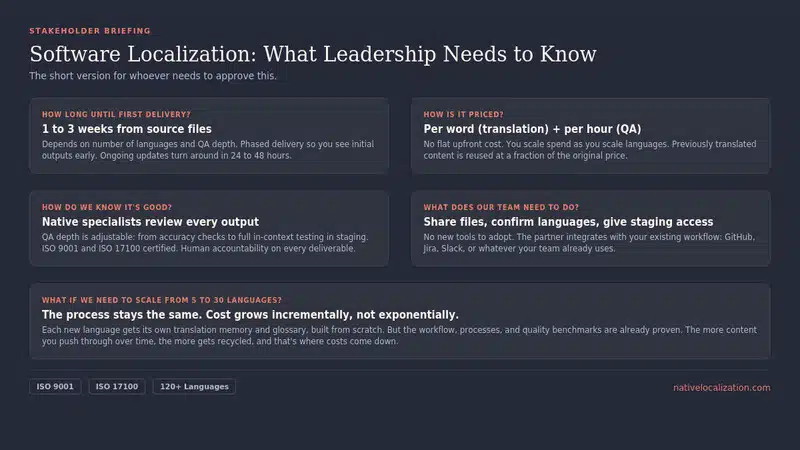
A breakdown of what drives the price, from per-word rates to engineering hours and ongoing maintenance.

What localization planning looks like at startups, scaling SaaS, and enterprise. Real cases and where your budget should go.
FAQ
Software localization quality measures how natural and effective your product feels to users in a target language. It goes beyond accuracy. A product can be translated with zero grammatical errors and still sound unnatural because the word choices, sentence structure, and tone don’t match how people in that market actually communicate. Quality localization sounds like it was written in that language, not translated into it. For marketing content, this distinction becomes even sharper — we break down what native language marketing actually sounds like compared to translated copy.
AI predicts the next word based on patterns in its training data, which includes academic papers, technical manuals, and content written over the last twenty years. The output tends to be grammatically correct but stylistically dated. For languages like French, where modern business writing is conversational and direct, AI often produces text that reads like a textbook rather than a product interface. AI also follows source text structure too closely, resulting in word order and phrasing that feels foreign to native speakers.
The incremental cost of human craft over AI-only translation is relatively small compared to total localization spend. For a SaaS product localizing into five languages, the difference between AI-only and AI with proper human review and adaptation might be a few thousand euros per quarter. Given the revenue at stake in those markets, it’s a strategic investment rather than a cost item. See our full breakdown in the software localization cost guide.
Common signs include feedback from internal team members who read the target language, user support tickets mentioning confusing messages, lower conversion rates in localized versions compared to English, and competitors in your target market with noticeably better localized copy. Sometimes the signal is just a feeling when you compare the English and localized versions side by side, even without reading the target language.
Translation quality focuses on whether the meaning transfers correctly between languages. Localization quality asks whether the experience feels natural. A translated button label might be accurate but nobody in that country would phrase it that way. A localized error message might use different words than the English version but communicate the same intent more effectively. Localization quality is about the user experience, not just the language accuracy.
Yes. We regularly assess localized products for teams that suspect quality issues. We review your product in the target languages, flag where the language sounds translated rather than natural, and provide specific recommendations. This can be a standalone review or the starting point for an ongoing localization partnership.
One e-mail a week. Smarter localization.
Real localization advice from a team that does it daily. One email a week, worth your time.
You're in.
We'll send you our best stuff. No filler.